deep reading in a digital world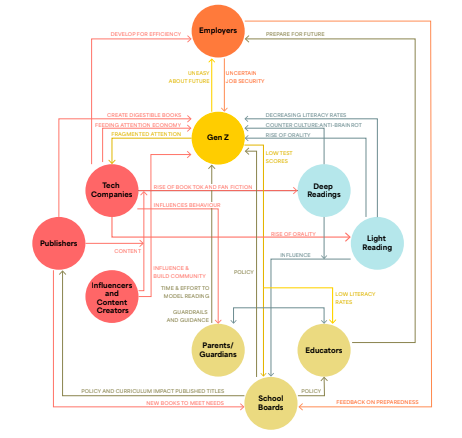
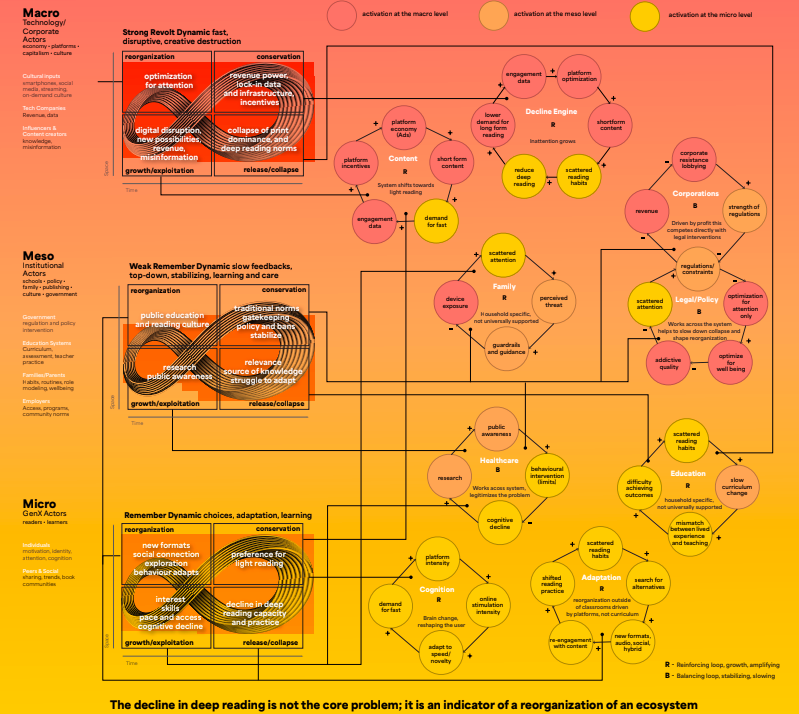
Through Map the System, a global competition, my group and I were asked to rethink a social issue through systems thinking, going beyond disciplines and questioning deeply held assumptions.
The Project
Explored whether reading is on the decline, but iterated on this topic several times through continuous research and visualization methods
Conducted desk research to understand if reading was actually declining by using the STEEPV Method
Discovered that the way we read has changed and that, actually, deep reading was declining due to the attention economy shaping our reading culture, quietly and quickly
The Process
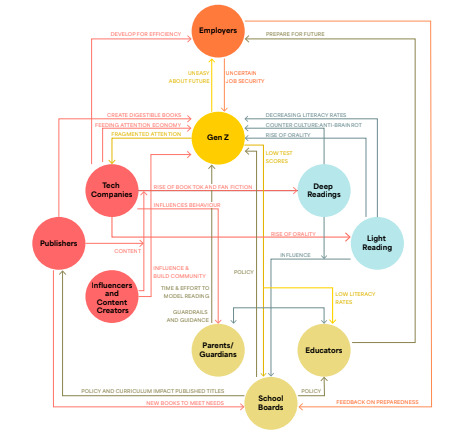
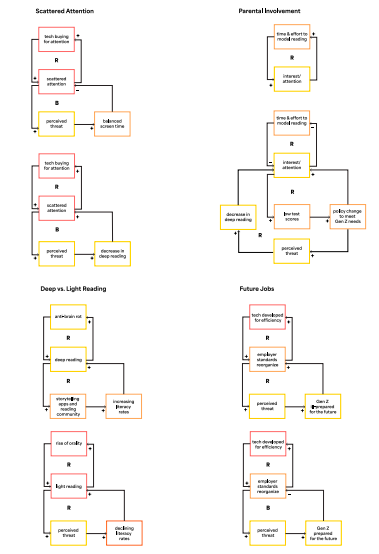
Once we had narrowed down our problem to deep reading in a digital world, we began using the Boundary Critique Method to map our system. We then used several other maps and methods to understand the intricacies, dynamics, relationships, structures, and levers of change within a system
Maps include: Cynefin framework, actor mapping, rich pictures, gigamapping, Causal loop diagrams, iceberg model and more
The levers of change led us to various intervention points within our system. Addressing the attention economy itself was the most prominent solution. Indicated that we’re favouring efficiency and speed over depth and analysis
We determined that the solution could take the shape of platform designs that encourage focus or regulations that view attention as something to be protected
Created with: Molly Hill, Mica McCurdy & Alison Solis